Update: Reading al-Khwārizmī
It's been a while since I last posted; here's what I've been up to.
A few months ago I found myself approaching Sībawayhi burnout, so I decided to turn my attention to another project I started pondering a few years ago: a new translation of the book that gave birth to modern algebra: al-Khwārizmī's كتاب الجبر والمقابلة Kitāb al-Jabr wa-l-Muqābalah, which I tentatively translate as "The Book of Curation and Reconciliation". Al-Jabr is fairly clear: its original sense is bone-setting or mending, hence curation of defects (many other translations are possible). Al-Muqābalah is much harder to translate; I prefer reconciliation (for now at least), because I think it accurately reflects what al-Khwārizmī had in mind in using the term, even if it fails to convey the etymological sense of muqābalah.
But what does algebra have to do with Sībawayhi, or grammar generally? In a nutshell: al-Khwārizmī's algebra is very much an Arabic algebra. His thinking is shaped by his language. When I first read the text (Rosen[1]'s bilingual edition of 1831, easily findable on the internet), I was struck by two things. First, he begins by looking at "what people need in reckoning (حساب)", and he finds "all of that is number". But then he says: "and I found that all of what is enunciated, of the numbers..." [emphasis added] is based on the unit. They key term here is "enunciated" (مَلفُوظ) - he's not talking about numbers in the abstract, he's talking about the way people talk when they solve problems of reckoning. He repeats this term a few lines later, where he says of "individuated numbers" (العَدَد المُفْرَد) that they are "what is enunciated (ملفوظ به) without relation to roots or squares."
It turns out that key aspects of his argumentation are rooted in the grammatical structure of Arabic. A vivid example is the way the Arabs expressed what we today would call subtraction. To express e.g. "10 - 3" they said "a ten except a three" - that's a ten excepting or excluding a three, not an expression of the arithmetic operation of subtracting three from ten. So "a ten except a three" is a compound noun expressing a kind of defective ten - hence the term jabr (جَبْر) for the method of "restoring" the integral ten, not by "adding" a three, but by removing the deficiency, the ناقص nāqiṣ (decremental/subtractive, but not "negative") three.
But what really caught my eye is this fragment from the same passage:
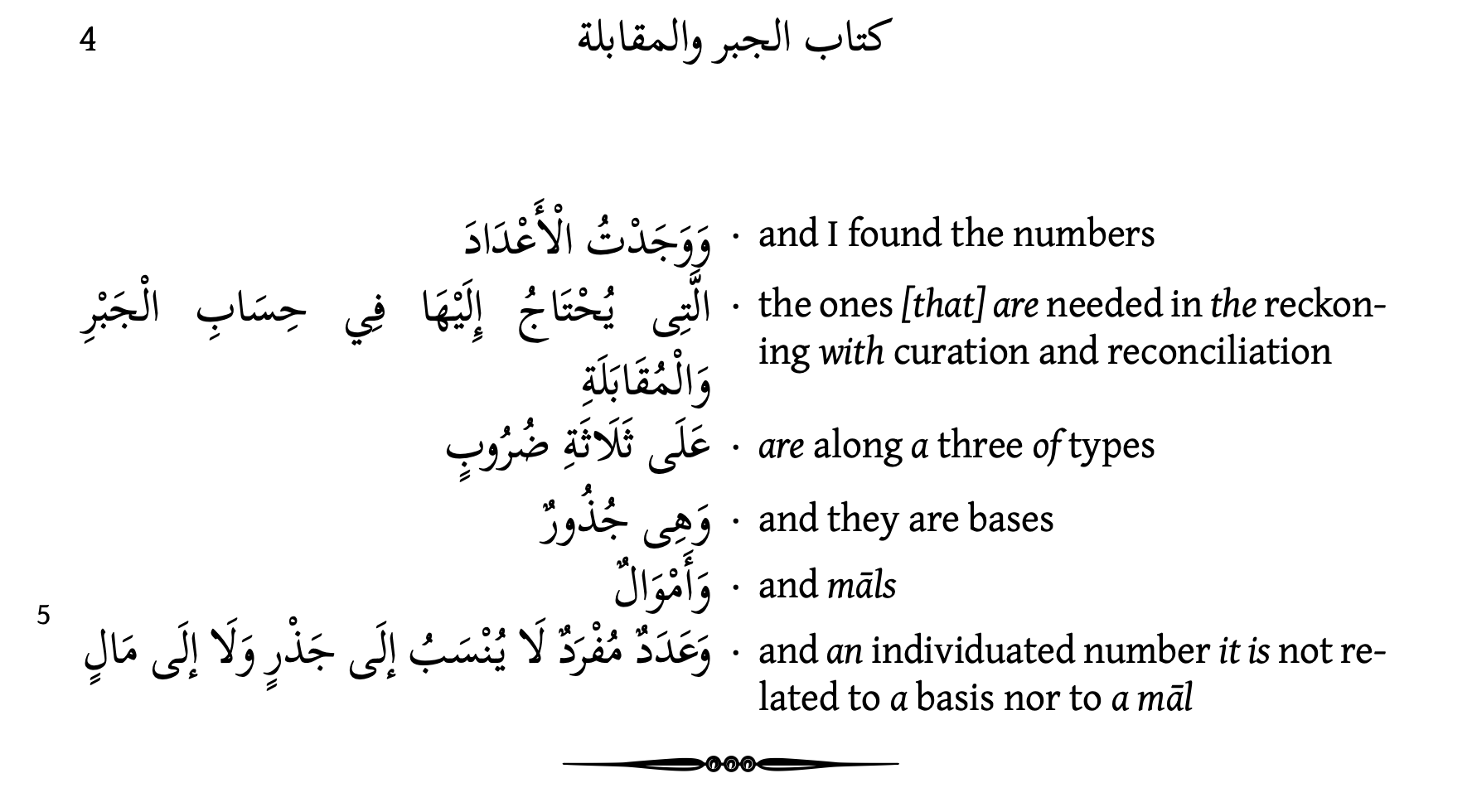
Readers familiar with Sībawayhi's Kitāb will instantly recognize the uncanny similarity between this categorization numbers and the classification of Arabic words with which Sībawayhi begins his book:

Sībawayhi's classification is primarily semantic - nouns express things, verbs express actions, and all other words (which is what he means by ḥarf حَرْف) contribute to meaning, but do not express things or actions.
Al-Khwārizmī's categorization is more purely grammatical. Roots (bases) and "squares" (māls) are never free-standing: a root is always a root of its square, and vice-versa. The "individuated" numbers are not, as most translators seem to think, "simple" numbers, but numbers unrelated to roots and squares. When people talk through calculations, they may use such individuated numbers without relating them to any other units. For example, "a square and ten of its roots are equivalent to 39" - that must mean "39 of something" (like dirhams), but failing to mention that "of what" is not an error; its just the way people talk.
Furthermore, this notion of "related to" is very clearly cousin to the grammatical notion of Ɂiḍāfa إضافة , "association". This concept has been widely misunderstood by Western scholars, but I'll save discussion of that for another article. Here, suffice it to say that مُفْرَد mufrad, "individuated", which al-Khwārizmī uses for numbers unrelated (unassociated) to roots or squares, is exactly the term Sībawayhi uses for nouns that are not "in (Ɂiḍāfa) construct". Take for example, حِمارُ الرَّجُلِ ḥimāru _r-rajuli, "the donkey of the man". Here حِمار "donkey" is مُضاف إلى الرجل "associated to the man". But if we drop the association, and just say something like هذا حمارٌ haða ḥimārun "this is a donkey", then "donkey" is مُفْرَد, "individuated", not associated/related to something else, grammatically or semantically. The parallel with al-Khwārizmī's "individuated numbers" is quite striking, in my view.
I've found lots of other interesting little tidbits as I've worked through the book. The first draft of the translation is complete (well, of the first part of the book; I'm not going to translate the second part, titled كتاب الوصايا, "The Book of Bequests".) Typesetting is almost complete. I'm using Lualatex (an extension of LuaTeX) with paracol and lots of other LaTeX packages, and I must say, you can do pretty amazing things with these tools, if you know what you're doing and don't mind some teething pains. Here's another example:
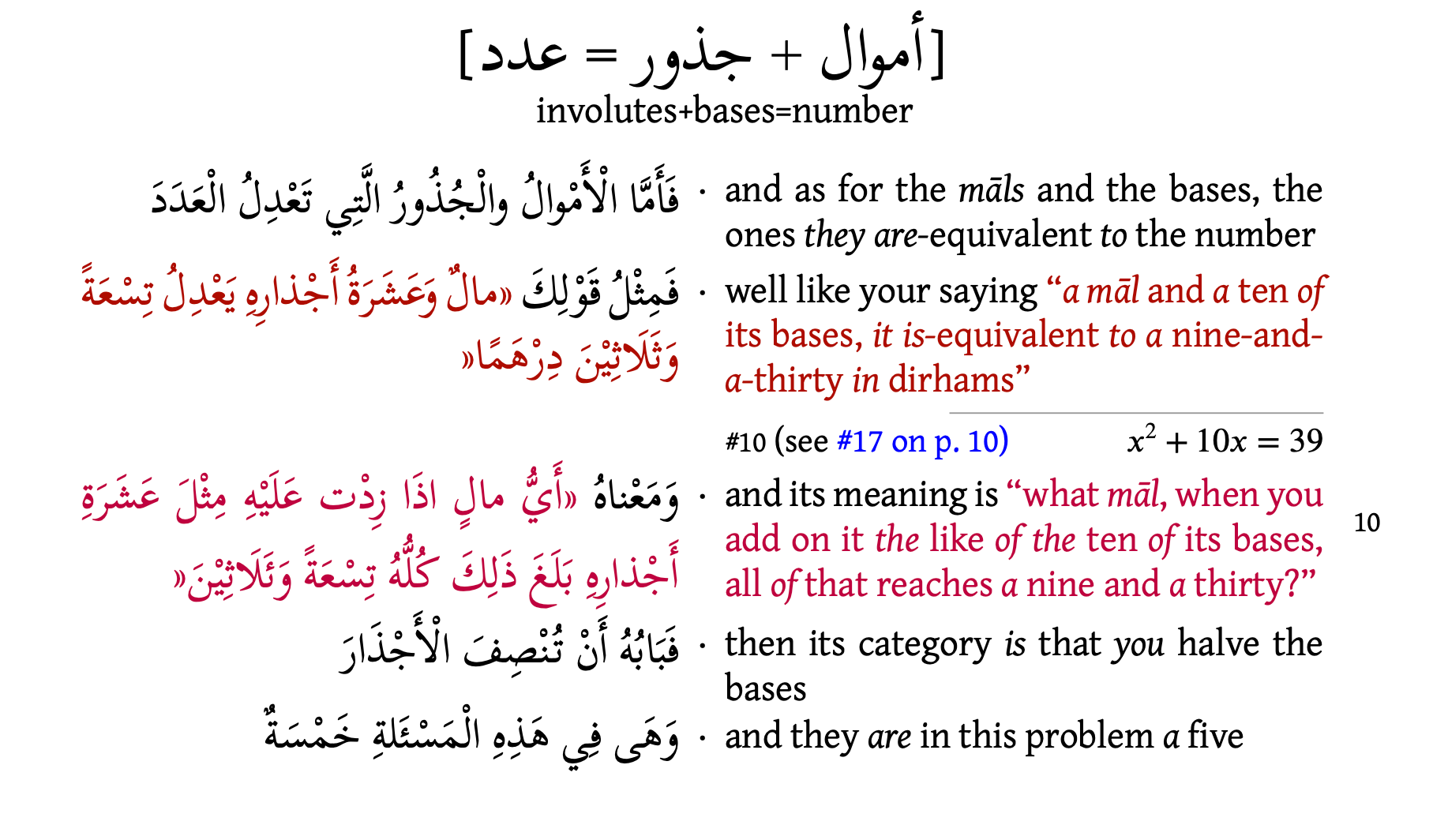
I've got an index of terms, list of problems, list of figures, etc. all very nicely typeset, so I expect that the book will be very easy to use. I've also indexed all problems to their locations in the three published editions I know of, so it will be easy for readers to check my translation against the others.
Another few months and it should be ready to go. Then it will be back to Sībawayhi!